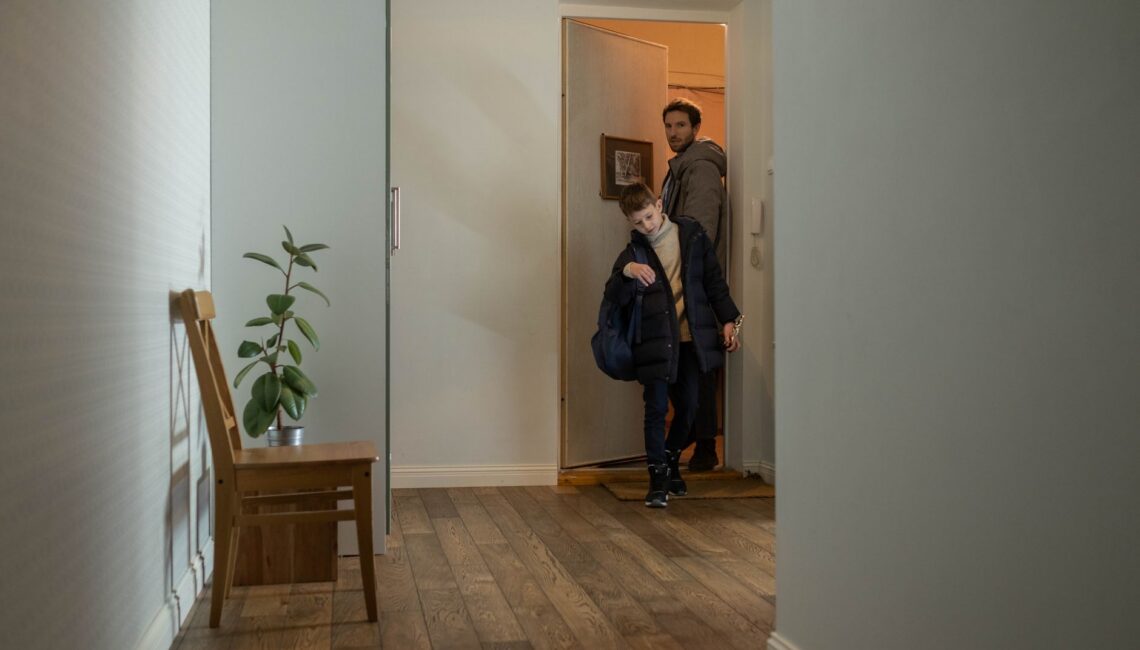
The slam happened like a punctuation mark I didn’t see coming. One loud, hollow crack of a bedroom door, then the muffled stomp of feet down the hall. He was eleven yesterday—eleven and a half today—and standing there in mismatched socks, hair sticking up like a kid who’d lost a fight with a pillow. “Just go,” he said. Not loud enough to split the house, loud enough to make me fold myself into the doorway and consider every possible answer that would land somewhere between dramatic and pathetic.
I handed him a clean T‑shirt. I wanted to be the calm coach, the guy who offered a timeout and a towel without commentary. Instead I put it on the bed and said, “Okay,” which felt like both a surrender and a strategy. He didn’t take the shirt. He didn’t look up. He closed the door halfway—maybe not even on purpose—and the small gap turned into its own geography: a sliver of light, the sound of his breath, the faint scrape of a pen across paper. Later, when I checked the doorway, the shirt was still there, folded the way he likes it, like a flag on neutral ground.
Now I am at my desk in a cubicle that smells faintly of burnt coffee and printer toner, one of those meetings where your camera is off and everyone pretends mute is the same thing as listening. My finger is on the mouse; the spreadsheet is a grid of numbers that could be anything, and my brain is a bad TV channel that keeps replaying the way his hand hovered over the door handle. I find myself nodding at the monitor when no one can see it, because inside I am editing the scene, softening my tone, trying every line that would’ve undid the slam at home.
> I feel something that belongs to grief and inventory at once: a nostalgia for stages not yet closed. It’s a weird ache—like missing last season’s championship team during training camp. You’ve still got all the players, you still hear the locker-room jokes, but there’s an awareness that the roster is changing. He’s ostensibly the same kid who once asked me to braid his hair for a costume and tucked a Lego astronaut under my pillow for luck. But in that doorway, the astronaut felt smaller, and his questions are fewer and more barbed. The longing is anticipatory; I miss the ease before it’s actually gone.
My father was a man who measured closeness like stats—games attended, shingles fixed, the types of advice he could rack up in a single sentence. I remember him sitting at the kitchen table, newspaper folded like a shield, a cup of coffee cooling while my recital or game wrapped up half a room away. We had a kind of rhythm that was loud and practical. I thought I’d break that pattern by being louder in different ways—by attending every practice, by showing up with carved-out time. Turns out you can schedule presence and still miss the softer engineering of connection: the little domestic inventions that make a kid feel unremarkable and loved at the same time.
On the field, I knew how to call a play, when to go for forty and when to settle for three. There’s a confidence in that—muscle memory, statistics, a scoreboard you can point to. Parenting through these early adolescent skirmishes doesn’t come with a scoreboard. The metrics are absence and tension and sometimes, the mercy of a small text at 2 a.m. asking, “U up?” You trade the adrenaline of competition for the patience of long plays. It’s both maddening and magnificent: I’m still wired for tactical wins, but the victories now are invisible. He didn’t want the shirt. He didn’t want me to pass through the gap. For now, that is a kind of defense. It’s also a signal that the kid in the doorway is trying to learn how to be himself, which is a thing I should celebrate even as it unravels my stomach.
When he was small, fights took the form of chaos—spilled cereal, tears in public, tantrums that cleared out the grocery aisle like bad weather. Those were exhausting in the moment and easy to file away after. This is different: emotional weather with no forecast. The house is quieter but not empty; the silence is more deliberate. He practices independence by closing ranges: less hand-holding, more closed doors. I catch evidence of the child I raised in small, stubborn places—a crayon drawing pinned to the bulletin board, a half-eaten sandwich in the fridge with a note that says “don’t touch,” a sticky pile of guitar tabs he hasn’t abandoned. They’re not relics; they’re signatures.
Nostalgia usually shows up like a postcard, wrapped in sepia. This nostalgia is fluorescent-lit and current. I miss the bedtime hum of him asking for one more story even as I watch him walk away. I miss the simplicity, not because I want to rewind but because knowing that it’s still available if I reach for it terrifies me with its fragility. It’s an odd gratitude: I am grateful for the distance because it means growth, and simultaneously terrified by how quickly the map can change. The math here is ugly—time moves faster than muscle memory. You can’t prepare for every pivot.
At my desk the spreadsheet flashes; the meeting drones. I think of the half-closed door as an invitation before it disappeared—an unspoken ask to learn a new kind of patience. Part of me wants to be the veteran coach who storms the locker room and corrals the team back into order. Another part wants to be the guy who sits on the bench and watches, who knows when to pass the ball and when to let the kid score his own ugly goal. Both instincts are true and both are wrong in their own time. The tension between them keeps me honest.
When the call ends, I catch myself writing a note in my planner: “Check door tonight.” It reads like a ridiculous thing to write at work, but it’s a promise with a timer on it, and promises are how I measure my integrity these days. I’ll come home and find the shirt where I left it or gone. He might be sulking or strumming or quietly working on something I don’t understand. Maybe he’ll shove the door all the way open and ask a question that sounds small. Maybe the half-closed door will stay where it is for a while. I don’t know. That’s the point—I don’t know. But the not-knowing has a flavor I recognize from being on the edge of a big race: nervous, electric, slightly ridiculous.
I can pretend to be in control. I can chart plays and schedule the nights I’ll attend and the conversations I’ll have. Mostly, I show up and bear witness to the messy, evolving man he’s becoming. There’s a childish part of me that wants to hold onto every small, quiet thing—proof that the kid who once needed me to wipe his nose still exists. There’s an adult part that recognizes closures as openings, and a stubborn athlete in me that will keep practicing the things that matter most: patience, presence, and the ability to take the loss of a little moment and keep playing anyway.
Tonight I will stand at the foot of that half-closed door and do what fathers do half the time: try things, fail sometimes, and try again. I’ll fold the shirt differently. I’ll pretend my voice is calmer than it is. Maybe he’ll let me in. Maybe he won’t. Either way, I’ll see the small gap of light and remember that missing something doesn’t always mean it’s gone. Sometimes nostalgia is an early warming-up lap—an attention shift that tells you to slow down and pay more attention before the whistle blows.