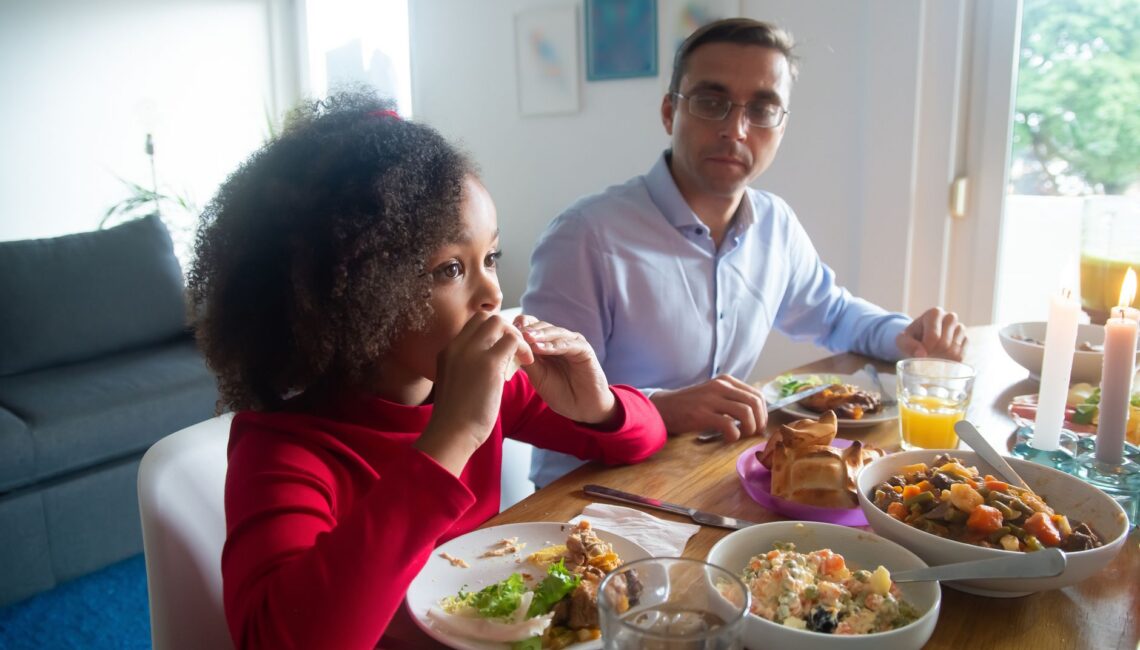
We were halfway through dinner when I told the spaghetti story.
You know the one every family has. The harmless classic. The greatest hit. The story you pull out because it used to make everyone laugh, including the kid it was about. In our house, it was about the time my son was four and called spaghetti “basketti” with complete confidence, then got furious when we corrected him because, according to him, we were the ones saying it wrong.
I was mid-sentence, fork in hand, doing the voice I have apparently been doing for seven years, when he looked up from his plate and said, “Dad, can you not tell that one anymore?”
Not mean. Not dramatic. Not even embarrassed, really.
Just done.
The table did that small family pause where everyone pretends they are still chewing but really they are checking the weather in the room. His sister looked at me. My wife looked at him. I looked at my taco like it had answers.
“Yeah,” I said. “Of course.”
And then, because I am a highly evolved emotional adult with years of self-awareness and restraint, I immediately tried to act like I had not just been mildly body-checked by the passage of time in front of a bowl of shredded cheese.
I made some joke about retiring the material. He gave me a half-smile, the kind tweens use when they still love you but do not want to encourage you too much. Then dinner kept moving. Somebody asked for more sour cream. Somebody spilled water. Somebody made a face about onions. Normal family noise filled the space where that little sentence had landed.
A few hours later, I was driving home alone after dropping him off at a friend’s house.
He had asked if I could pull up two houses before the driveway. Not a big deal. Not a rejection. Just a strategic tween maneuver designed to reduce parental visibility. I respected it. I stopped where instructed, watched him grab his hoodie, check his hair in the reflection of the passenger window, and step out into the evening like he had somewhere to be.
“Love you,” I said.
He turned back just enough and said, “Love you too,” but softer than normal, like the volume knob had been adjusted for the neighborhood.
Then he walked toward a cluster of boys on the sidewalk, all legs and sweatshirts and terrible posture, and I pulled away.
The car felt strange without him in it. Not empty in a tragic way. Just noticeably lighter. Like when you finish a hard workout and the adrenaline is gone, and all that is left is the weight of your own breathing.
I kept replaying dinner.
Can you not tell that one anymore?
It is such a reasonable request. Honestly, it is healthy. He is allowed to grow beyond the toddler version of himself. He is allowed to retire a story that no longer feels like him. I know this. I even admire it. There was a confidence in the way he said it that made me proud. He did not snap. He did not sulk. He just drew a line.
And still, damn.
There is a weird grief in realizing your kid has become aware of his own mythology. For years, you are the keeper of the stories. First steps. Weird words. Bath-time disasters. The time they fell asleep sitting up with a cracker in their hand. You carry these little artifacts around like proof that you were there, that you paid attention, that all those exhausted years were not just a blur of car seats and Goldfish crumbs.
Then one day they look across the dinner table and remind you those stories do not belong only to you.
That hit me harder than I expected.
When he was little, he loved that story. Or maybe he loved that we loved it. There is a difference, and I am only noticing it now because he is old enough to show me. Back then, he would laugh when we laughed. He would repeat the word wrong on purpose. He would perform himself back to us, and we would clap like idiots because that is what parents do. We turn ordinary moments into stadium events.
I am a former athlete, so part of me understands replay culture. You make a good play, people talk about it. You mess up in a funny way, people talk about that too. Locker rooms are built on old stories. The catch, the miss, the time somebody puked during conditioning. You survive by learning to laugh at yourself.
But fatherhood keeps exposing the flaw in every old system I trusted.
A kid is not a highlight reel. He is not a blooper tape. He is a person under construction, and apparently construction crews do not appreciate you walking through the job site pointing at the old foundation and saying, “Remember when this was adorable?”
I turned onto the main road, passing the pizza place where we used to take him after soccer when his shin guards were bigger than his legs. I could still see him in the backseat at five, cleats banging against the plastic seat protector, hair sweaty, cheeks red, asking if he scored a goal when he had spent most of the game chasing the wrong direction.
Now he knows the score. Now he knows who is good and who is pretending. Now he knows which shoes are acceptable and which words will get you roasted for three months. His world has rules I do not fully understand, and my job is shifting from carrying him through it to standing nearby with snacks and car keys, trying not to be weird.
No one warned me that parenting a tween would feel like being demoted and promoted at the same time.
He needs me less in the obvious ways and more in the subtle ones. He does not need me to cut his food, but he needs me to notice when his shoulders drop after reading a text. He does not need me to hold his hand crossing the street, but he needs me to not laugh when he asks a question he is pretending not to care about. He does not need me to tell the spaghetti story. Maybe he needs me to remember it privately.
That is the part nobody sees. The editing.
We edit our language. Our expectations. Our jokes. Our facial expressions. We learn when to celebrate loudly and when to give a quiet nod like a sideline coach whose player just made the right pass. We swallow the comment. We retire the nickname. We stop posting the photo. We let them become less available to the world because they are becoming more responsible for themselves.
It feels noble for about four seconds, then it feels like getting benched in a game you care too much about.
I thought about my own dad then. How he used to tell stories about me at family gatherings that made everyone laugh. Nothing cruel. Nothing that would scar anybody. Just old stories from when I was small and loud and convinced I could do anything. I remember being twelve and suddenly hating them. Not because they were false, but because they were too true in a version of me I was trying to outrun.
I wonder if he felt that sting when I stopped laughing.
At the time, I thought he just liked embarrassing me. Now I think maybe he was reaching for a kid who was already moving down the hallway, closing the bedroom door, turning up the music.
That is the brutal little joke of it. You spend years helping them become independent, then independence shows up at dinner and asks you to please stop doing the voice.
And the right answer is yes.
Not because it does not hurt. Because it does.
Because love sometimes looks like letting the old material die without making a ceremony out of it.
I pulled into the driveway and sat for a minute before going inside. No dramatic soundtrack. No grand realization. Just the soft tick of the engine cooling down and the faint smell of his deodorant still hanging in the car, too much of it, because eleven-year-old boys apply it like they are sealing a deck.
I smiled at that.
He is still little in ways he would deny under oath. He still leaves socks everywhere. He still forgets plates in his room like he is conducting a science experiment. He still wants me to watch the video, see the shot, hear the joke, inspect the Lego thing he swears is not a toy anymore. He still says love you, even if the volume changes depending on who might hear.
So maybe the sadness is not that he is gone from that younger version. Maybe it is that I cannot visit it with him whenever I want.
I have to carry it differently now.
Quieter.
With more respect.
There is pride in that, though it wears a heavy coat. My boy told me what he needed without blowing up the room. I heard him without turning it into a lecture or a wounded dad performance. That is not nothing. Around here, some nights, that counts as a win.
Still, I will miss “basketti.”
I will miss the way he said it. I will miss the little face that insisted we were all wrong. I will miss being allowed to tell the story out loud.
But I get it.
Some stories are not gone. They just move from the dinner table to the drive home, where a father can hold them for a few more miles before walking back into the house and learning who his kid is becoming next.

