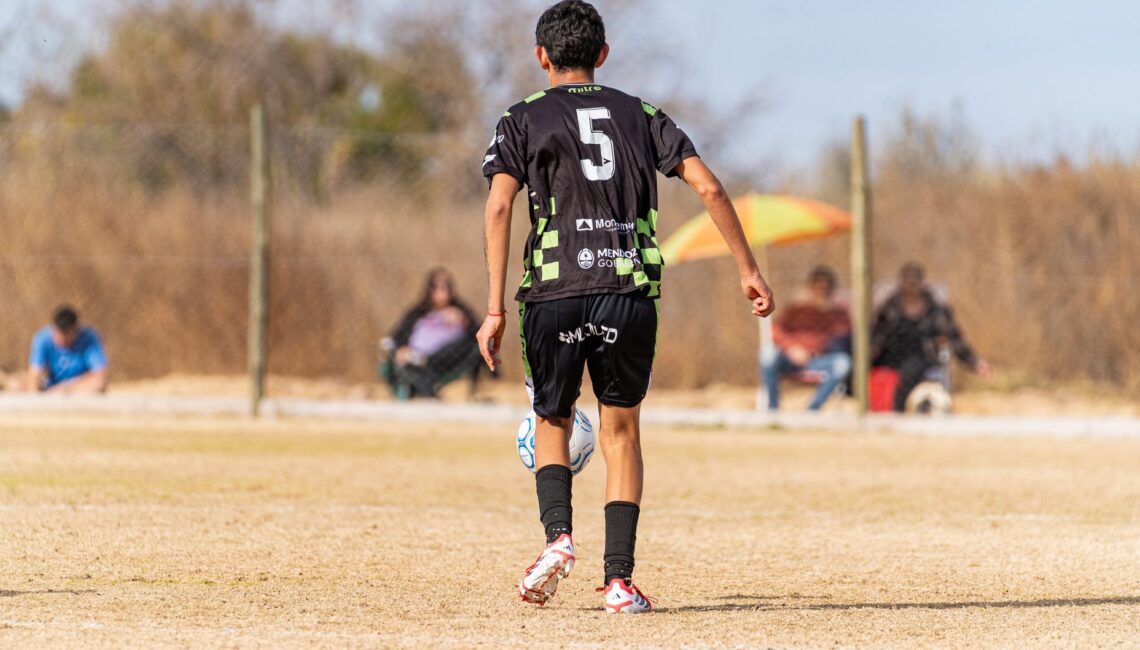
He went down near the far sideline, which is the worst possible place for a father to watch his teenager hit the ground because it gives your imagination a full forty yards of open space to sprint.
One second he was chasing a loose ball, long legs trying to decide if they belonged to a grown man or a kid who still leaves cereal bowls in the basement. The next second there was contact, an awkward twist, and my son was on the turf with one hand on his ankle and the other palm flat against the ground like he was trying to steady the whole planet.
The game kept moving for half a breath. Then the whistle came. Then the coach started jogging over. Then every parent on our sideline did that thing where we tried to look calm while silently checking our children for permanent damage from a distance. I could feel my heartbeat in my teeth.
I did not run onto the field. That feels important to say because every cell in my body wanted to. When he was six, I could scoop him up without asking anyone’s permission. When he was nine, I could jog out during a timeout with a water bottle and a fake casual voice. At fifteen, there is an invisible line painted around him. You can see him. You can love him. You can worry yourself into a full internal medical drama. But you do not cross onto the field unless someone waves you in.
So I stood there like a statue with sunglasses on, pretending to be the type of man who trusts the process.
Inside, I was an absolute mess.
It was not even a dramatic injury, not really. No ambulance. No screaming. No crowd going quiet in that heavy way. Just a teenage athlete sitting on the turf a little too long while his father, who once prided himself on being composed under pressure, suddenly became a worst-case-scenario machine in running shoes.
By the time I got home later, the panic had cooled down into something I could handle. Which apparently meant I carried a basket of laundry into our bedroom and started folding socks with the intensity of a man defusing a bomb.
There is something humbling about folding your teenage son’s clothes after watching him get hurt. His shirts are almost my size now. Some of them are actually mine, borrowed without ceremony and absorbed into his rotation like territory claimed by a taller, moodier nation. His practice shorts are balled inside out. His socks are stiff with grass and sweat and whatever else grows in the ecosystem of a high school sports bag.
I stood there matching socks and replaying the moment he went down, over and over, because fatherhood loves a loop. The body comes home, but the mind stays on the sideline, scanning for clues. Did his foot roll? Did his knee buckle? Did he grab high or low? Was his face pain or frustration? There is a difference, and any sports parent knows we pretend we can read it from seventy yards away.
When I was young, getting up mattered. That was the whole code. If you got hit, you got up. If you were hurt, you walked it off. If you were injured, you tried very hard not to let your face tell the truth until you were somewhere private. I do not say that like it was all bad. There was a kind of toughness in it that shaped me. Discipline. Resilience. A stubborn refusal to fold when things got uncomfortable.
But there was also a lot we didn’t say.
Now I am raising a son in the aftermath of my own old locker-room education, trying to figure out which parts to hand him and which parts to leave in the past. I want him to be tough. I do. I want him to compete, to push, to discover that his body and mind can handle more than he thinks. I want him to know the quiet pride of getting knocked down and choosing to stand.
I also want him to know he is allowed to hurt.
That is where being a former athlete and a current father gets complicated as hell. The competitor in me wanted him back in the game if he was okay. The dad in me wanted to wrap his ankle in ice, wrap his whole life in bubble wrap, and cancel contact sports until further notice. The reasonable adult in me understood both impulses were a little ridiculous and neither one should be driving the car alone.
He sat there while the coach talked to him. I watched his shoulders. That is how you read teenagers sometimes. Not their words, because the words are usually fine, nothing, chill, I know, stop. But the shoulders are honest. His were tight at first, high and angry, which gave me a weird kind of relief. Anger usually means embarrassment. Embarrassment usually means pain has not taken over completely.
Then he stood up.
Not fast. Not heroic. No movie score. Just a slow, careful stand. He tested the foot once, then again. He nodded at the coach. He limped a few steps toward the bench, and every parent around me exhaled like we had all been holding the same borrowed breath.
I did not realize how scared I was until the relief showed up.
That is one of the strange parts of having teenagers. The emergencies get quieter, but not smaller. When they were little, panic announced itself. Fevers, falls, sharp corners, choking hazards, the sudden silence from the other room that meant someone had discovered markers or gravity. You responded with your hands. You picked them up. You checked their mouths. You cleaned the cut. You kissed the exact spot.
With teenagers, you stand farther away.
You stand behind a rope, behind a fence, behind their pride, behind their need to not have you make it weird. You learn to parent with restraint, which sounds mature until you are doing it and realize restraint feels a lot like helplessness wearing nicer shoes.
After he came off, he would not look over at me right away. Of course he wouldn’t. Fifteen-year-old boys do not want to meet their father’s worried eyes in front of teammates unless absolutely necessary. So I waited. I watched him sit on the bench. I watched the trainer tape something. I watched him take a drink. I watched him finally glance over for half a second.
I gave him the smallest nod I could manage.
He gave me one back.
That was the whole conversation.
And honestly, it felt like winning.
Not the kind of winning I used to chase. Not scoreboard winning. Not proving something to a coach or an opponent or some imaginary critic who lived in my chest and kept demanding more. This was a smaller, stranger victory. I did not embarrass him. I did not make his moment about my fear. I did not sprint across the turf like a lunatic dad in quarter-zip fleece. I stood there, let him be an athlete, let the coach coach, let the trainer assess, let my son have his own body in public.
Then, twenty minutes later, I was back to being a basket case with cotton T-shirts.
I folded one of his hoodies and found a granola bar wrapper in the pocket. I paired socks that looked like they had survived a war. I turned one practice shirt right side out and caught that sharp smell of sweat and rubber pellets and adolescence. It is not a sentimental smell. Nobody is bottling it for a candle. But it hit me anyway.
This is the evidence of his life happening beyond me.
The dirt. The tape. The crumpled schedule. The clothes that no longer fit neatly into the categories I understand. Boy sizes became men’s sizes without asking my permission. His shoulders are broadening. His voice has settled into a lower register. He can look me almost straight in the eye now, which is both awesome and deeply rude.
I remember holding his tiny socks years ago and wondering how anything that small could belong to a real person. Now I hold his game jersey and think, when did this person become so solid? When did his bruises stop being mine to inspect? When did love start requiring me to stay put?
He came into the room while I was still folding. Phone in hand, one earbud in, walking with only the slightest hitch.
I tried to play it cool. I failed, but only a little.
How’s the ankle?
Fine.
Need ice?
I already did.
Want me to look at it?
Dad.
That one word contained an entire legal document. Back off. I’m okay. Please care, but less visibly. I heard it. I respected it. Mostly.
He grabbed a clean shirt from the stack before I had finished folding it, which should have annoyed me more than it did. Instead I watched him limp out, taller than yesterday somehow, and I felt that odd mix of pride and leftover fear that seems to define this stage. He was okay. Not invincible. Not fragile. Just okay. For tonight, that was enough.
I kept folding after he left, smoothing sleeves, stacking shorts, making order out of the soft wreckage of the week. It occurred to me that so much of fatherhood at this age is learning where to put your hands. On the steering wheel while they tell you a story in fragments. In your pockets when they are frustrated and do not want a lecture. Around a laundry basket because you need something ordinary to do while your heart catches up.
I used to think being a strong father meant stepping in at the right moment.
Sometimes it does.
But sometimes it means staying on the sideline while your kid gets himself upright, then coming home and folding the clothes he will throw on the floor tomorrow like none of it was a big deal.
Maybe that is the deal now. Less carrying. More witnessing. Less control. More trust. Still close enough to feel the hit. Far enough away to let him stand.