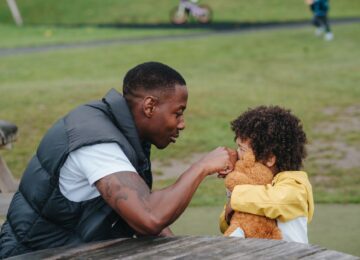
They were on the kitchen floor, knees bent, faces five inches apart, a green plastic T. rex between them like a tiny, valueless truce. One of them — four, windblown hair, the perpetual scab on his chin — gripped the dinosaur by the tail. The other — five, older by twelve months and two inches, already practicing the exasperated tone he thinks grown-ups use — had it by the snout. Both shouted at the same time, words and accusations tumbling into cereal dust and the morning sun slicing across the linoleum.
I remember the exact way the sun hit the cereal bowl, because when you’re standing between two children who believe a dinosaur is the fulcrum of justice, your peripheral vision becomes ridiculous in its clarity. I crouched, palms on my knees, practicing the calm voice I tell myself I have. “Hey. Stop. Hands to yourself.” It came out steadier than I felt. I said time-out more like a referee letting the whistle hang in his mouth than a dad doling out punishment.
They argued rules that only preschoolers could know: who found the dinosaur first, who held it last, who had been promised it by promise-making that exists in the ether of toy politics. Frustration tightened in my chest like an old jersey too small. I wanted order. I wanted to be the dad who intervenes with authority and structure, like a coach drawing up a play. Instead, I found myself bargaining: five deep breaths, then one minute of sharing, then no screens until dinner. I set penalties like a man who knows how to design a workout but is still figuring how to coach toddlers.
At the edge of my impatience was tenderness, though — a surprising, relentless tenderness that softened the sharp corners of my crankiness. The younger one’s lower lip quivered when I took the dinosaur and said we’d decide together. The older one’s jaw clenched; he was furious and embarrassed all at once, which is what grown men feel when they miss a layup in front of their buddies. I remembered my own brother at that age, competing for the remote, the last cookie, the glance from our mother. Back then, my father’s solution was scoreboard: points, privileges, made-for-adult justice. I felt my hands wanting to dole out the same medicine and then clamped them into my pockets.
After a few deep breaths that both of them mimicked with theatrical slowness, I sat down cross-legged on the floor and asked them to explain, one at a time, why the dinosaur mattered. The answers were small and enormous: because “it was mine,” because “it makes the roar noise,” because “I wanted to show you.” I listened like a coach watching film, noting the micro-expressions, cataloguing the priorities: attention, fairness, validation. Two preschoolers were running a league of grievances, and my role had shifted from ref to translator.
Now I’m at my desk, on an internal training call about compliance protocols — the sort of thing where everyone nods silently and the presenter clicks to the next sterile slide about risk mitigation. My laptop camera is off. My fingers are on the keyboard, not typing, as the presenter’s voice becomes white noise. Beside my monitor is a small photo of the three of us on vacation — the sun, the goofy smile I make when I’m trying to look candid — and my mind drifts back to the linoleum, to the dinosaur sitting on the counter like a tiny statue of the morning.
It’s ridiculous how quickly the brain switches lanes. One moment I’m calculating budgets and forecasting headcount, the next I’m replaying a tantrum in HD. The stapler on my desk suddenly seems like a gavel. I can hear the compliance trainer explaining escalation procedures; I translate them into parenting terms. Escalate to me if safety is threatened. De-escalate when you can. Document the incident — or, as I did, narrate the fight so each kid feels seen. The office is all policy and process, but the kitchen was pure human economy: who got what, who felt robbed, who needed acknowledgment.
There’s a noise that frustration makes in my chest — a flat, impatient hum — that I used to mistake for leadership. In sports, the guy who screams the loudest gets listened to. In a boardroom, the man who draws the line in bold gets credit. In my kitchen, that approach produces defeated children and a quiet after which someone sneaks an extra cookie. So I’m learning to be loud in different ways: loud with attention, loud with explanation, loud about naming feelings. It’s slower. It doesn’t have clear metrics. It doesn’t fit on a score sheet. But it trips my competitive wiring in a new direction — to win small truces that hold because they’re felt, not enforced.
Working through a spreadsheet now, I realize how much energy I spend compartmentalizing. I used to believe endurance was a physical thing — run farther, lift heavier, work later. Fatherhood extends that definition. Endurance is patience stretched over tiny battles. It’s choosing not to be the biggest voice in the room. It’s tolerating the ridiculous repetition of negotiation that feels like it will never end and then seeing your child properly apologize for the first time and understanding that the particular war you’re waging is less about good behavior and more about being held when it stings.
I confess to a moment of real pride that morning, too. Not the chest-out, postgame grin kind, but the small satisfaction of not reverting to the old playbook. I didn’t hand out punishments like power plays. I didn’t throw up my hands and wave a silent, exhausted surrender. I listened, I re-framed the problem, and I let them, in their half-formed logic, argue toward a solution. Still, there’s the whisper of doubt that trails me into the afternoon. Did I let them manipulate me? Did I miss a teachable moment about boundaries? The answers are not tidy; they’re a collage of small wins and recurring questions.
The call ends. I close the training window and I fold my hands on my lap like I did on the kitchen floor. There’s a softness that survives the shift from home to office, a residue of morning sunlight that follows me into corporate beige. I’m trying to hold two truths at once: that I can be a steady presence who doesn’t always resort to the loudest move, and that I am also someone who still wants a definitive scoreboard. Maybe the scoreboard now keeps track of gentler things: one less meltdown, one more heartfelt apology, the moments when my kids come to me not for punishment but to be patched.
At some point today I’ll be back in the house, probably stepping on a LEGO like it’s a landmine. I’ll referee again, because that’s what fathers do: we jump into the middle of the fray and try to do better than the last time. And when I tuck them in that night, I’ll replay their small faces in my head and feel both the old frustration and the new tenderness, braided together. No final whistle. No neat box checked. Just another morning, another tiny conflict that leaves me slightly more exhausted and slightly more willing to listen.