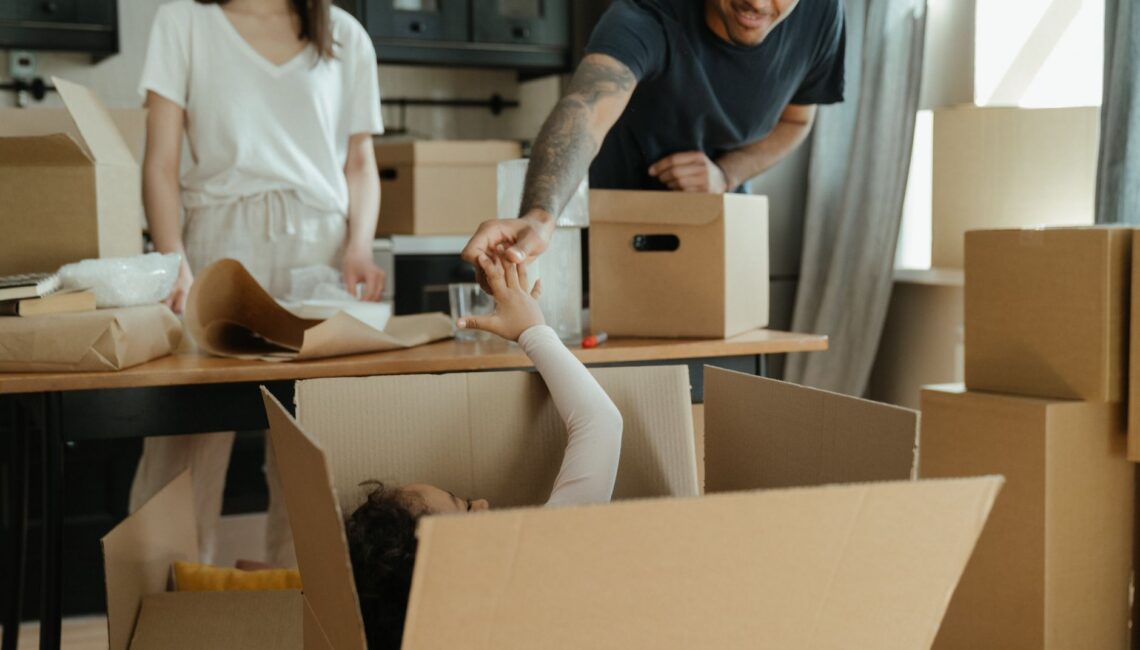
‘Dad, do not put the blue unicorn in the same box as the dinosaurs.’
My seven-year-old said it with the seriousness of a union representative, standing in the middle of her bedroom while I held a cardboard box under one arm and a roll of packing tape in my teeth. Her hair was half-brushed, one sock was inside out, and she had assigned emotional rankings to every object in the room with a level of authority usually reserved for military operations.
We were packing for the move. Not across the country. Not some dramatic tear-soaked goodbye to everything we had ever known. Just a move far enough to require boxes, labels, a truck, and the strange realization that your life is mostly made of things you forgot you owned until you have to wrap them in newspaper.
I thought I was ready for it.
I had a system. Of course I had a system. I am the kind of guy who turns loading a moving truck into a competitive event against no one. I had tape. I had markers. I had categories. Books with books. Clothes with clothes. Stuffed animals in one soft, efficient bag. Fragile items wrapped twice. Trash bags for donations. A schedule in my head. A quiet little scoreboard where I was winning.
Then my daughter handed me a rock.
Not a special rock by any normal adult measurement. Gray. Uneven. Probably from the driveway. She placed it carefully in my palm and said, ‘This one comes with us because I found it on the day I learned to whistle.’
And just like that, the system took a knee.
I stood there in her room, surrounded by half-filled boxes and loose puzzle pieces and the faint smell of crayons, holding a rock like it had been blessed. I wanted to say something useful. Something dad-like. Something efficient, maybe even tender but still forward-moving. Instead I just nodded and put the rock in a shoebox labeled IMPORTANT in her handwriting, where it joined three plastic bracelets, a birthday card from a classmate whose name she barely remembers, two seashells, a tiny notebook with four pages used, and a Lego person missing a head.
That box was a disaster from a packing perspective.
It was also, apparently, sacred.
Later that night, I could not sleep. I was lying on my back in bed, staring at the ceiling like it had answers, while the rest of the house sat in that weird pre-move condition where everything familiar looks slightly betrayed. Pictures off the walls. Corners exposed. Closets emptied. Echoes in places there did not used to be echoes.
My body was tired. That deep, satisfying tired I used to chase in training. Shoulders sore. Hands dry from cardboard. Lower back reminding me that being competitive about moving boxes is not the same thing as being twenty-two. I should have been out cold.
Instead, I kept seeing her room.
Not the room itself, exactly. The way she kept pausing before putting something in a box. The way she asked if her drawings would still feel like hers in the new house. The way she made me promise we would not lose the nightlight shaped like a moon, even though she insists she is not scared of the dark anymore. The way she tried to act big about leaving, then quietly slid her favorite stuffed dog into her backpack instead of a box, like she needed at least one loyal witness close by.
I did not expect to feel vulnerable about packing.
I expected stress. Irritation. Maybe impatience when nobody else respected the purity of my labeling system. I expected to carry heavy stuff and solve little problems and make sure the move did not turn into a complete circus. That is familiar territory. Give me a task, give me a timeline, give me something awkward to lift, and I can become a very useful man.
But this was different.
This was watching my kid decide what mattered.
And it hit me in a place I had not protected.
When I was her age, I remember adults packing like weather systems. They moved through rooms with purpose. They decided what was worth keeping. They talked about space, time, money, storage, practicality. Kid stuff was kid stuff. Important, sure, but only up to the point where it slowed down the grown-up machinery.
I do not say that with bitterness. My parents were doing what parents do. They were carrying the invisible weight. Bills. Jobs. Logistics. The thousand decisions kids never see. I probably handed someone a rock once and got told to put it in my pocket or leave it behind. Not cruelly. Just practically.
And now here I am, decades later, still wired for practicality, trying not to rush a seven-year-old through the grief of leaving a bedroom where she learned to read, lost a tooth, built blanket forts, and once taped a picture of a cheetah to the wall because she said it made her feel fast.
That is the strange part about fatherhood. You can be fully present and still feel yourself reaching for the old tools. Efficiency. Control. Humor. Strength. The stuff that helped you win games, finish workouts, keep your head down, make money, push through. Good tools. Necessary tools. But sometimes your kid does not need the tool you are proudest of.
Sometimes she needs you to stand there and understand that a rock is not a rock.
Lying awake, I thought about how much of being a dad is pretending the ordinary stuff is not quietly wrecking you. You hold the trash bag open while they decide whether a broken plastic crown can be donated, and suddenly you are thinking about time, change, mortality, your own childhood, interest rates, cardboard, and whether you have been too distracted lately. All because a child asked if the glow-in-the-dark stars on the ceiling could be peeled off and moved to the new room.
I wanted to be the steady one. I still do. There is a part of me that believes fatherhood is a long game of absorbing impact. Take the hit. Stay upright. Keep everyone moving. Be the guy who knows where the tape is.
But there in the dark, I had to admit something I did not really enjoy admitting.
I was sad too.
Not dramatically. Not in a way that needed a speech. Just quietly sad that this version of our life was getting boxed up. Sad that I could picture her smaller in that same room, belly-laughing in footie pajamas, and also picture her now, tall enough to reach the second shelf, correcting my packing choices like a tiny project manager. Sad that I am always asking time for just a little more room, and time keeps shrugging like, sorry man, truck is already booked.
There was pride in it too. That complicated dad pride. She was handling it better than I expected. She was brave in the way kids are brave, which is not clean or consistent. One minute she was confidently explaining that her new room would need a reading corner and maybe a disco ball. The next minute she was asking whether the neighbors would forget her.
I told her they would not.
I hope that was true.
I hope a lot of things I say as a father are true.
That is another thing nobody tells you. You spend half your parenting life making promises on behalf of a universe that has not signed off on them. It will be okay. We will find it. You will make friends. I will be there. We say these things because we want them to be true, and because sometimes confidence is the blanket we throw over uncertainty so our kids can fall asleep.
Meanwhile, we lie awake staring at the ceiling, trying to negotiate with doubt.
I thought about ambition too, because apparently my brain enjoys opening multiple browser tabs at midnight. The move is connected to all the grown-up reasons moves happen. Opportunity. Space. Schools. Work. The future. The kind of things men like me tell ourselves we are doing for our families, and often we are. But even good decisions charge a toll.
There are sacrifices tucked inside progress. A commute changes. A routine disappears. A kid leaves the exact patch of carpet where she used to line up her animals for school. You gain something and still lose something. That does not make the choice wrong. It just means winning does not always feel like celebration.
In sports, I understood sacrifice when it had a clean scoreboard attached. You gave up sleep, comfort, weekends, whatever, because the result announced itself. Win or lose. Better or worse. Faster or slower.
Fatherhood is messier. You can make the right call and still watch your kid hug a doorframe before bed. You can provide more and feel, for a moment, like you are taking something away. You can be proud of the life you are building and ache for the life you are leaving.
That is where I was, wide awake, not solving anything.
The next morning, we will tape more boxes. I will probably get too intense about the garage. Someone will lose the scissors. My daughter will pack one box beautifully and another box with a shoe, a book, six markers, and a plastic banana. I will try to be patient and fail in small ways. I will apologize if I need to. I will carry the heavy stuff. I will protect the box marked IMPORTANT like it contains legal documents or gold bars.
Because in a way, it does.
It contains proof that she was here. That she noticed things. That her little life, which looks chaotic from the outside, has its own landmarks and ceremony. A whistle rock. A headless Lego person. A moon nightlight. Evidence of a childhood in motion.
I used to think strength looked like not being moved by much.
Now I am not so sure.
Maybe strength is being moved and not running from it. Maybe it is letting a seven-year-old teach you the difference between clutter and treasure while you stand there with tape stuck to your forearm, pretending you are not getting a little misty over a damn pebble.
I did not sleep much that night.
But I stayed there in the dark, awake with the weight of it, letting the move become more than a checklist. Letting myself feel the cost of carrying a family forward. Letting the old room exist a little longer in my mind before the truck came and the boxes left and we began again somewhere else.
Some things you pack.
Some things you carry.