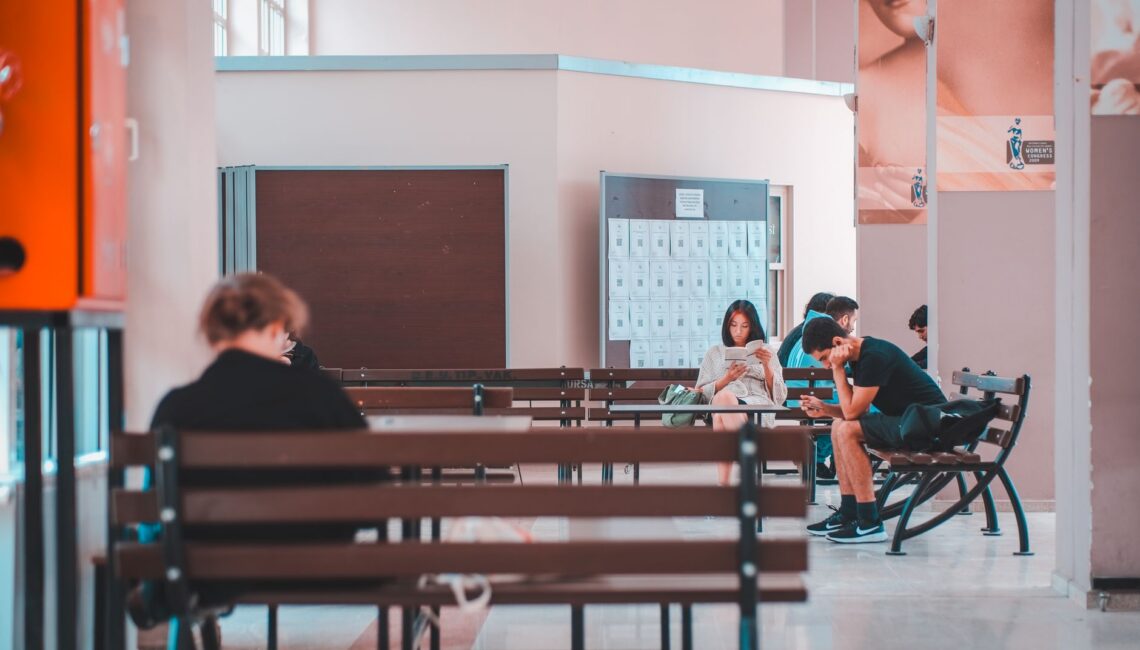
He sat two chairs away from me in the sports medicine waiting room like I had a contagious disease.
Hood up. One AirPod in. Phone held low in that teenage way where somehow the screen is both private property and national security. His ankle was wrapped, his face was flat, and ten minutes earlier in the car he had told me, with surgical precision, “Can you stop making everything a lesson?”
That one landed.
Not because he was wrong. That’s the problem with teenagers. Sometimes they swing wildly and miss. Sometimes they throw a fastball right over the plate and you just stand there watching it hit the catcher’s mitt.
We had been arguing about his injury. Or his attitude. Or my tone. Or the fact that I asked one too many questions after practice. It started with me trying to be involved and ended with him staring out the passenger window like I was a podcast he didn’t subscribe to but couldn’t turn off.
I had said something about rehab. About doing the little things. About how seasons are built in the boring moments. Classic me. Former athlete dad, still hearing whistles in my head, still believing discipline can solve most problems if you just apply enough pressure and ice.
He said, “You’re not my coach.”
And there it was.
The sentence every sports dad probably earns eventually if he sticks around long enough and talks too much.
So now we were in the waiting room, surrounded by outdated magazines, a vending machine humming like it had unresolved trauma, and a wall poster of a smiling kid wearing a knee brace like it was a personality trait. My son had arranged his body in full defensive formation. Knees out. Shoulders curved inward. Thumb moving. Face unreadable.
I wanted to say something.
That is my great curse as a father. I want to say something. I want to clear the air. Repair the connection. Explain my heart. Defend my intent. Apologize, but also maybe clarify that I am not a complete idiot. I want to step into the huddle and draw up the next play even when the game is clearly telling me to sit my ass down.
So I sat there.
Which, for me, should qualify as a spiritual achievement.
Across the room, a little boy was licking the armrest of a chair while his mother negotiated with him like a hostage specialist. I remember those years. The public sweat. The diaper bag. The snacks. The constant low-grade fear that your kid was about to become feral in front of witnesses. Back then, fatherhood felt physical. Carry this. Wipe that. Chase him. Catch her. Lift, buckle, rock, repeat.
Teenage fatherhood is weirder.
You are still responsible, but you can’t always touch the problem. You can’t scoop up a mood and put it on your hip. You can’t distract a fifteen-year-old with a cracker and a set of keys. Their pain has passwords now. Their world is partially happening in group chats you will never see, on fields where they are judged by peers, in mirrors, in algorithms, in quiet comparisons they would rather die than admit out loud.
And there I was, this guy who used to think effort was the answer to everything, sitting beside a boy becoming a man, realizing my effort might be the very thing crowding him.
That should have felt sad.
But then he snorted.
Not a laugh. Not yet. Just one involuntary burst through his nose. He tried to hide it, which made it better.
I looked over.
He kept his eyes on his phone and said, barely moving his mouth, “This dude just air-balled a dunk.”
He held the phone out halfway. Not all the way. Let’s not get dramatic. But halfway. A treaty offer.
I leaned in.
On the screen, some poor kid on an outdoor court took off with the confidence of a Greek statue and the vertical leap of a folding chair. The ball sailed over the rim, over the backboard, maybe into another zip code. Then he landed and immediately tried to pretend he meant to do it.
I laughed.
My son laughed too.
And I mean really laughed. Face cracked open. Teeth showing. Shoulders bouncing. The same laugh he had when he was six and thought the word “underpants” could heal the nations. The same laugh that used to come from the backseat when I made monster noises at red lights. The same laugh, somehow deeper now, hidden under acne cream and sarcasm and a hoodie he wears in weather no human should wear a hoodie in.
I felt joy hit me so hard it was almost embarrassing.
Not a calm, mature, fatherly joy. Not the kind you could put in a tasteful caption under a black-and-white photo. This was stupid joy. Loud inside my chest. Ridiculous. Like winning a state championship because your teenager voluntarily showed you a twenty-second video in a waiting room that smelled like hand sanitizer and old carpet.
I wanted to grab the receptionist by the shoulders and say, “Did you see that? He included me. My son, who currently thinks I breathe wrong, just let me into the joke.”
I didn’t, because society has rules.
But I wanted to.
Instead I said, “He committed to the lie at the end. Respect.”
My son nodded, still laughing. “Honestly, elite recovery.”
Elite recovery.
There it was again, the bridge. Not a big one. Not a cinematic bridge with music swelling and two generations finally understanding each other. Just a little plank tossed across a gap. A shared dumb video. A phrase. A laugh. A reminder that distance isn’t always disappearance. Sometimes it’s just your kid pacing the perimeter of himself, checking the fence line, making sure you’ll still be there when he circles back.
I sat in that waiting room trying not to look too happy, which is a strange and underrated parenting skill. Teenagers can smell parental delight. If you display too much of it, they retreat immediately, like deer hearing a twig snap.
So I played it cool.
Badly.
I stared at the poster of the knee brace kid and pretended to be a normal man, while inside I was doing backflips I could not have physically completed even in my athletic prime.
This is the part nobody really explains when your kids are little. You think the big emotional moments will announce themselves. First steps. First words. First day of school. Big games. Graduations. You prepare for those. You take pictures. You get sentimental on schedule.
But sometimes the moment that wrecks you is your teenage son moving one chair closer without acknowledging he moved one chair closer.
Because he did.
After the video, he slid over. Not all the way against me, obviously. He’s fifteen, not a golden retriever. But one chair. The empty chair between us disappeared.
I felt it like a scoreboard change.
And because I am still me, competitive wiring and all, some part of my brain whispered, We’re back. We’re good. You survived the possession.
Then another part of me, the part fatherhood keeps sanding down, whispered, Don’t spike the ball, idiot. Just sit here.
So I did.
I thought about my own dad a little. Not in some heavy, dramatic way. More like a flash of recognition. How hard it must have been to parent a version of me who believed silence was strength and independence meant making sure nobody knew what hurt. How many times did he try to get close and find me two chairs over? How often did I mistake his concern for criticism because I was young and proud and allergic to being understood?
I wonder if he ever sat near me wanting to say less but feeling more.
I wonder if I ever gave him a halfway-open door and he had to act casual about it.
Fatherhood has a funny way of making you retroactively generous. You start forgiving things you didn’t even know you were still holding. Not because everything was perfect, but because you finally understand how clumsy love can be when it’s wearing work boots and carrying expectations.
The nurse called his name.
He stood up, limped a little, and looked back at me.
“You coming?” he asked.
Two words. Nothing poetic. No apology. No grand reconciliation. Just an invitation into the next room.
And damn if I didn’t feel like I’d been handed a trophy.
I followed him down the hallway, trying not to crowd him, trying not to coach his limp, trying not to turn the whole thing into a speech about resilience. I failed slightly, because I asked, “Pain level?”
He gave me a look.
I raised both hands. “Right. Shutting up.”
He smiled.
Small. Quick. Gone almost immediately.
But I saw it.
That’s the whole job sometimes, isn’t it? Not fixing the distance. Not winning the argument. Not proving your intent was pure or your instincts were right. Just seeing the smile before it disappears. Catching the half-offered phone. Recognizing the chair that isn’t empty anymore.
I walked into that exam room still carrying the sting of what he said in the car. I also walked in buzzing like a man who had just been let backstage at his own kid’s life for twenty seconds.
Both were true.
That seems to be where fatherhood lives now. In the both. Proud and bruised. Needed and annoying. Too much and not enough. Standing in a fluorescent hallway behind a teenager who is trying to become himself, feeling an unreasonable amount of happiness because, for one ordinary minute, he let me come with him.