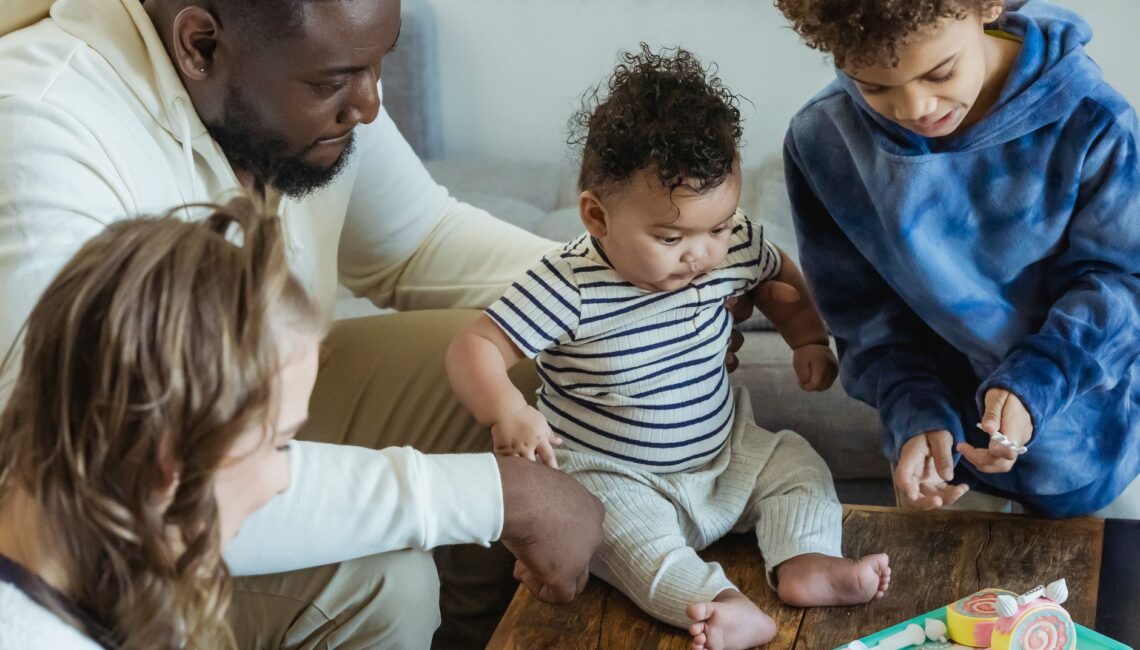
He had the blue car and she had the blue car, and for two tiny, furious minutes the living room resembled a low-budget WWE ring. The boys — not boys, children, four and five, small enough that a shove looks ridiculous and dangerous at the same time — were a tangle of limbs and complaints. I stepped between them with the puzzled confidence of a coach breaking up a scuffle: palms out, voice pitched calm and firm like I was calling a play. It worked for five seconds. Then one of them clamped his hand on the other’s wrist and the other responded by shrieking as if I’d just asked him to run a marathon.
I remember watching my hands do things I would have sworn I didn’t know I could do: scoop a weeping child onto my hip, pluck the offending vehicle into my palm, and use the sort of clipped, no-nonsense sentences that belong in locker rooms and elementary classrooms. “No hitting. Take deep breaths. Cars go in the box.” It felt ridiculous to be giving tactical instructions about toy custody, and suddenly my chest buzzed the way it does before a race: quick breaths, a heat behind the eyes, that small animal panic that says, solve this now or let it escalate.
We were halfway through the timeout choreography — separate chairs, toys out of reach, stern faces on both kids — when the turned-out light on the hallway clock made the moment feel bigger than it was. One kid clenched his lip and then, like someone deflating a balloon, started to calm. The other sat with his head bowed, furious and exhausted. I left them ten feet apart and left the room because that’s what adults do in fights: remove the referee to defuse the bout. Then I sat in the van for sixty seconds and decided a trip to urgent care for a modest bump on the forehead was the parents’ version of icing a knee. So here I am now — fluorescent lights, a faded children’s magazine, the plastic smell of a waiting room — replaying what just happened and feeling every version of myself at once.
There’s a tiny, humiliating part of me that expected to be better at this. Not better as in never having to referee — that’s unrealistic — but better at staying rooted, at keeping my voice level, at not sounding like a dry coach trying to sell breathing exercises to two people who still believe everything should be decided by show-and-take. I trained for pressure. I lived for stakes. My brain knows how to map out drills and punishments and motivational speeches. In a different life I would have analyzed three misalignments in toy-sharing protocol and written a playbook. Instead, I fumbled through empathy and authority at the same time, and for five minutes I was clumsy and human.
What hit me hardest in the waiting room was how fast the panic migrated into a different place — not exhaustion exactly, more like the slow unspooling after a workout when your muscles surrender and you realize they did what you asked. Sitting under those humming lights, I found myself oddly proud. The kids didn’t need a perfect ref; they needed boundaries that didn’t feel like war. They needed the certainty that someone would step in and end the round without drama and without turning one kid into a villain. I had done that, imperfectly, and they were okay. Their breaths slowed. The world’s tiniest scab was forming on a forehead bump. The kid who’d been furious put his hand on his sibling’s knee on the sly and then pretended nothing had happened. That small, stealthy truce felt like a stadium full of applause.
Memory kept surfacing as I waited. I remembered the fights my brother and I had — how ours always escalated until someone got legitimately hurt and then our dad would come in like a reaper and make us stand with our arms across our chests while he did a seriousness speech. There was clarity to that model: consequence, order, end. But it also left this scar of silence that I noticed only years later, a kind of performance of stoicism that taught us to swallow everything and move on. I don’t want that for my kids. I don’t want them to learn to hide the messy middle when something hurts. So I blunder toward the opposite: a messy, noisy intervention that looks a lot like care.
There’s also the athlete in me, wired to fix things with schedules and drills. When a fight breaks out, my mind immediately wants a routine: warm-ups, de-escalation, warm-down. I tried to do that between the cluttered coffee table and the couch, and it felt absurd. This game doesn’t have a playbook that applies across seasons. Today, the timeout worked. Last week, it was sticker charts and a lot of sighing. The sport I’m playing now isn’t about winning a title; it’s about surviving the season intact and finding small, repeatable moments of peace. It’s endurance, not sprinting.
What surprised me in the waiting room was the relief, which doesn’t get as much airtime as the panic. Relief is quieter, but it’s also more precise: the slow exhale when you realize the worst-case scenario didn’t happen. I found myself smiling at a cartoon on the wall because the kids were both asleep in the back of the car — a miraculous truce born of exhaustion. The tension I’d been carrying in my neck unknotted. My palms stopped sweating. The urgent-care clerk called our name and the nurse asked the perfunctory questions, but my head stayed in that small domestic victory: two kids, two hearts still beating, one stolen peace in a chaotic afternoon. It’s a shitty little thing to celebrate, and also everything.
Parenting is weird like that. The stakes are small and enormous on the same day. A broken toy can feel like the end of the world and a scraped forehead is a near-catastrophe until you sit under humming lights and watch a child doze, mouth slack, hair sticking up like a protest. You hold your own judgment up to the fluorescent truth and you see what you are: a man who once measured success in podiums and PRs, now measuring it in seconds of calm between sibling wars.
I leave the waiting room with a lopsided sense of victory. Not because I solved anything permanently — how could I? — but because I remembered how the rules are simpler when you stop treating every fight like a final. Sometimes the job is just to interrupt the escalation, scooch the chairs apart, and provide a warm lap when a tiny human needs one. The rest gets figured out with time, slow habits, and a ridiculous amount of forgiveness.
Outside, the sun is bright and my kids bicker quietly about who gets to hold the blue car on the walk to the car. I catch myself tightening like a coach at the sideline, ready to shout instructions, but I let the moment go and watch them negotiate. Is that mastery? No. It’s practice. And right now, in the tiny stadium of our driveway, that feels enough.